

Welcome back to Glass Half Full and thanks for reading!
I JERKED awake, bolting upright in bed, a loud bang ringing in my ears. Was it real, or from a dream? It was the small hours of the morning and the house was quiet. I didn’t hear Anne stirring, so whatever it was, it hadn’t wakened her. But if it was a dream, I couldn’t remember it, as usual. I lay awake for an hour, trying not to think what the dream might have been about.
I decided I’d never get back to sleep. I got up, put on the robe that came with the room, and sat in a chair by the window. Moonlight glinted off the lake without a shimmer, it was that still. I looked at it for a while, my eyelids drooping. I fell asleep that way, waking up hours later with a crick in my neck, blinking at the sunlight streaming in.
I could hardly look at Anne at breakfast. I must have looked pretty haggard, considering how concerned she seemed when she brought me more coffee. I pushed aside her questions with talk of my plans for the day. No way was I going to bring up the lamp and any possible connection to her husband’s death. I guessed she hadn’t heard of Dolores’s wild theory, but I couldn’t risk finding out for sure. The less she knew about it, the better.
Yesterday, running down the lead on the lamp had seemed like a lark. Now it felt deadly serious. Had Anne caused her husband’s death? I didn’t believe it — either that it was possible, or that she would wish for such a thing. We’d only had a few conversations during breakfast or at teatime, but I felt like I knew her. If she was putting on a front of grief, then I was no judge of character. Or maybe I didn’t want to believe I could be so wrong about someone. Either way, I was going to find out.
After breakfast, I drove out to the Lost Lake Municipal Golf Course. Everyone at Al’s the previous night agreed that’s where I’d find the mayor at ten on a Thursday morning. I had to hand it to him for using the town’s facility. In my experience, city bigwigs hung out at the more exclusive country club courses, the better to let the lobbyists and their money do the talking without the riff-raff overhearing.
The course covered rolling, forested hills a couple of miles out of town, with farmland adjacent. The drive out was bucolic, as to be expected. The modest clubhouse nestled up against the pines, the first hole carving a narrow lane through the forest on either side. Plenty of places to lose a ball. I wished I’d brushed up on my game before heading north.
I pulled the old, incomplete set of clubs from the trunk of my car. It had been my father’s, and was hopelessly behind the modern technology. But I’d done okay, back when I’d played one or two times a month. Problem being, that was a couple of years ago.
I went into the clubhouse, paid my fee, and put my chit into the basket of singles looking for partners. Mine was the only one. At 9:55, in walks the mayor — I recognized him from the city’s website — and two other guys.
The mayor greeted the clubhouse attendant, then looked over at me, “Looks like we’ll have a foursome today, gentlemen.” He walked over to me and held out his hand. “I’m Clinton Sharp.”
“Jim Pulaski.”
Sharp’s eyes narrowed. “Our visiting detective.”
“News travels fast. I know you won’t hold it against me. I was hoping to join you for a round, and maybe ask a couple of questions.”
“Eh, why not? I’ve pretty much run out of things to talk about with these fellows.” He introduced his partners, Stan and Bill, one a dentist and the other a local builder, I didn’t get which. “You’re staying at Wainwright House, if I’m not mistaken.”
“That’s right.”
“Phil was our fourth, for years and years. I’m sure Anne has told you about him.”
“Some. I’m sorry for your loss.” I looked around at the threesome. “He must have been irreplaceable, like John Bonham.” None of them appeared to pick up on the reference. “I hope I can fill his shoes.”
Sharp looked me up and down. “More than — Phil wasn’t a large man.”
Neither was the mayor — short and wiry, with silver hair trimmed barely off the ear, clean-shaven, horn-rimmed glasses.
“It’s our turn,” Stan said.
“We don’t usually use carts, since it’s never crowded on a Thursday morning. Is that all right, Jim?”
“Sure,” I said, though it had been a while since I’d carried a heavy bag the length of nine holes. Back when I’d golfed, I didn’t like to mix it with what was essentially backpacking. Leave the walking to the pros and their caddies, I’d always felt.
We headed out to the green. They gave me the honor of teeing off first, and I immediately shanked the ball into the trees.
“Good power,” Sharp said, “but this first hole is a bit unforgiving. It’ll open up at the second tee.”
They kindly called that a breakfast ball and let me try again. I did better on my second chance. We fell into pairs as we walked the green, and the mayor looked over at me.
“I hear you were curious about the fire at Anderson’s.”
“Yeah, couldn’t help noticing it on the way into town. Then the guys at Al’s Bar said the town’s had a run of bad luck, and maybe you had an opinion on it.”
The mayor hit a nice approach shot, but on my next shot I put our ball into a sand trap. “It’s the darnedest thing,” Sharp said as he eyed the ball. “The last couple years, it seems like we can’t catch a break.”
“What kind of bad luck have you had?”
He told our partners to go ahead and putt while he dug around for his sand wedge. They were already giving me suspicious looks. “Every kind. Not just that mysterious factory fire. We’d been banking on that new development down at the waterfront. The main investors pulled out a year ago, and now all we have is an empty lot.”
“Yeah, I noticed that when I took a walk on the boardwalk. I’m no investor, but it seemed like prime real estate.”
“The legal wrangling is going to keep that property tied up for years. It would have brought in a lot of jobs, more amenities for visitors, more housing for locals, which we’re starved for like everywhere else.”
Sharp made a good shot to get us onto the putting green, and I finished the hole with a lucky putt. We were already two strokes down on our opponents. The mayor took his turn to tee off for us. He may have been a small man, but he hit the ball like he wanted to murder it. It was a good shot, straight down the fairway, giving us a chance to par the hole.
“One development falling through isn’t exactly a pattern,” I said as we walked the green.
“But I could name you five other things that have gone south. Too much to cover in nine holes. First there was the state community-building grant. We relied on it to put on festivals and fairs and such. But our last two applications have been denied, for vague and arbitrary reasons. And tourism is down, while it’s up everywhere else. Our hotels and AirBnBs have so many cancellations, it’s hard to explain. Some of the guests up and leave in the middle of their stay, move on somewhere else. It’s like no one can have a good time here anymore.”
“I’ve noticed that, walking around town. No one looks happy, like they should when they’re on vacation.”
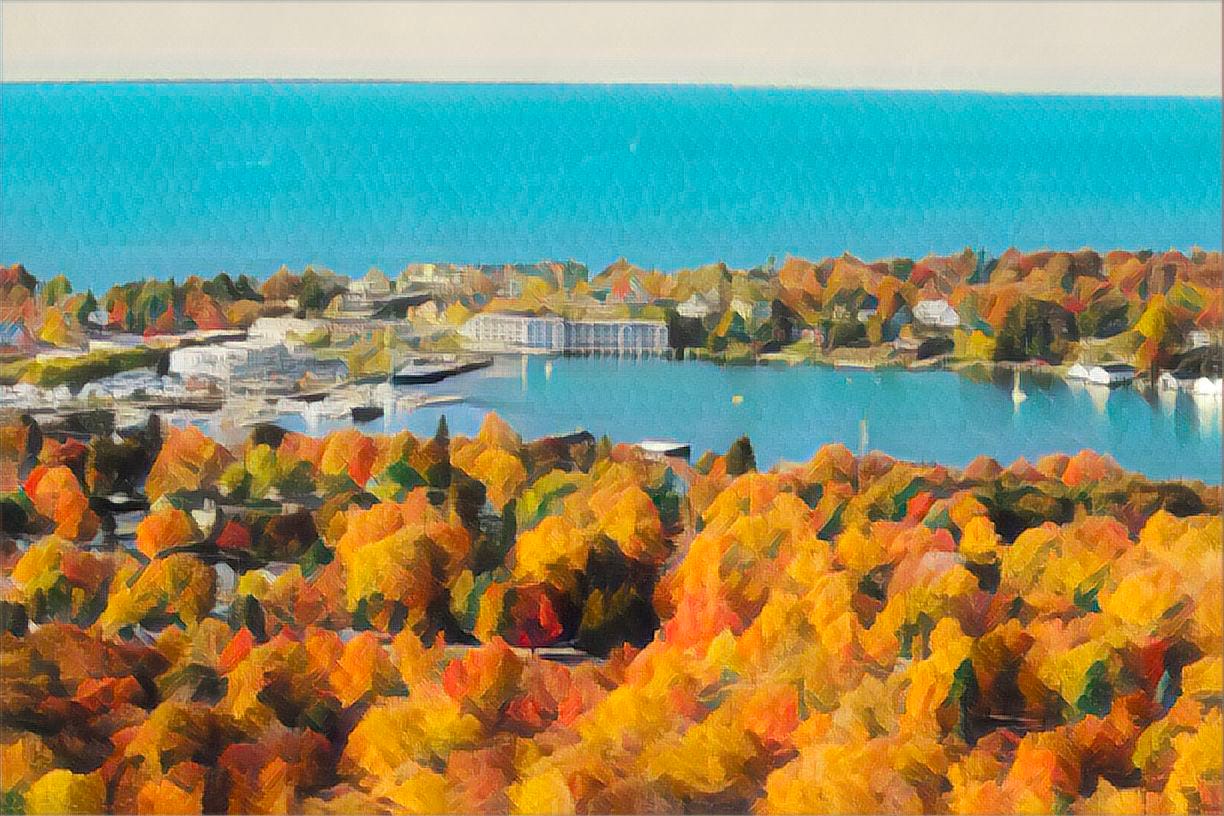
The mayor paused to chat with our partners as we took our drives from the third tee, then continued our conversation once they were out of earshot. “Here’s another thing. I hesitate to mention it, or you might think I’m crazy. Last year’s fall colors were way off, hardly any color at all.”
“Seems like a natural occurrence.”
“But everywhere around us had a great leaf-peeping season! First we had this micro-drought that only affected the area right around here. The maples and birches and whatnot started losing their leaves before they could really turn. After that, it was a windstorm, took off all the leaves that were left, right when it should have been getting good. And it was the same thing, the windstorm hit us and nowhere else.”
“That must have affected tourism.”
“Ya think? No one wants to look at bare trees in October. Bookings for this season are down forty percent from two years ago. And we used to be known as one of the best fall color spots in Michigan, second only to the Tunnel of Trees.”
We’d pulled even with Stan and Bill as we finished the third hole. The mayor hit his next drive to the side of the green, swearing under his breath. I think it was probably intentional. “Your partner’s rubbing off on you,” Stan kidded him.
“That does seem like a lot of bad luck,” I said as we walked over to our ball. “You’re sure nothing good has happened?”
“Oh, people keep having babies, kids graduate high school and get into their favorite colleges, that kind of thing. But overall, no. In fact, the last really outstanding thing I can remember was when Marjorie, our town librarian, won the lottery. Big one, too. Couldn’t have happened to a nicer person.”
“Did she stay, or light off to Florida with her winnings?”
“No, she’s still here, running the library. In fact, that’s been good for the town, since she’s given a lot of it away to the food pantry, the homeless shelter, the community theater, and on and on.”
“When did that happen?”
“Let’s see, two winters ago, the last time we held the Old-Time Logging Festival.”
“And when did this run of bad luck start?”
“Oh, not long after that. It was spring when we found out the logging festival wouldn’t get funded again. You know, if I didn’t know better, I’d think we’d been cursed. But I can’t let myself think that way. I have to believe we’re turning the corner. We have another investor lined up for that waterfront property, if we can just get through the legal wrangling.”
I couldn’t blame the mayor for seeing this run of bad luck as more than a coincidental string of events. When a quarter lands heads up enough times in a row, you naturally begin to suspect it’s weighted.
“About that logging festival. I hear you used a blue lamp in one of the displays, one you got from Amos’s?”
The mayor pulled up short. “You’ve been talking to Dolores, haven’t you?”
“Could be.”
“But that’s crazy! A magic lamp? She’s out of her mind, and you are too if you believe that BS. It’s a run of bad luck, not a curse.”
“Look, I don’t believe in magic lamps either. I’m just trying to keep my mind open to all possibilities. It’s an awfully suspicious pattern, you have to admit, and it coincides with your purchase of the lamp. I’m assuming you dusted it before you put it on display?”
“You’re saying I cursed the town?”
“Not at all. If it is the lamp, no one knows how the damned thing works. But rubbing it does seem required.”
“I’m done with this conversation. I told you, we’re turning the corner on this losing streak, and talk of magic lamps doesn’t help.”
We’d reached the sixth hole. If the mayor looked like he wanted to murder the ball before, now he looked like he was trying to strangle the club. His shot made it to the putting green. After that, he made a point of sticking close to his regular partners, chatting with them about the weather and the Tigers’ prospects, leaving me feeling like a fourth wheel.
If this had been a regular investigation, it was at the stage I liked to call “ruffling some feathers.”
Thanks for reading! If you enjoyed this installment, please give it a like, a comment, or share it with your friends. And if you really liked it, I hope you’ll subscribe or upgrade your subscription.